 InspectDay
Blog
Thermal camera for home inspection
A thermal camera can show where insulation is inadequate or missing, but ASTM says an image alone does not prove it, and ASHI's 2026 standard, approved and not yet in force, does not require the inspector to use one.
By InspectDay ASHI's standards, ASTM's practice and FLIR's C5 page, checked on 2 min read
What a thermal camera adds
ASTM’s practice is a guide to qualitative thermal inspection of building walls, ceilings, roofs and floors framed in wood or metal, where insulation sits between the framing members. It allows the detection of cavities where insulation is inadequate or missing.
FLIR’s page for the C5 lists its image files as standard JPEG, with 14-bit measurement data included.
What the standards say
The ASHI standard in force is the one effective March 1, 2014.
ASHI’s 2026 standard lists thermal imaging equipment, which it calls infrared cameras, among the equipment the inspector is not required to use. That standard is approved but not yet in force, and its implementation date is to be determined.
This page covers the ASHI standards. Your state’s rules may differ.
What a thermal image does not prove
ASTM says proof of missing insulation or a malfunctioning envelope requires independent validation. It names visual inspection and in-situ R-value measurement as validation methods, and places them outside its own scope.
How photos reach the report
On the phone, a finding is added with a description, a finding type and a location, and then takes photos and video. Photos and video attach to an inspection item and to its findings. On an item, Choose from device takes up to ten photos or videos at a time.
The web app uploads photos and video, with no annotation.
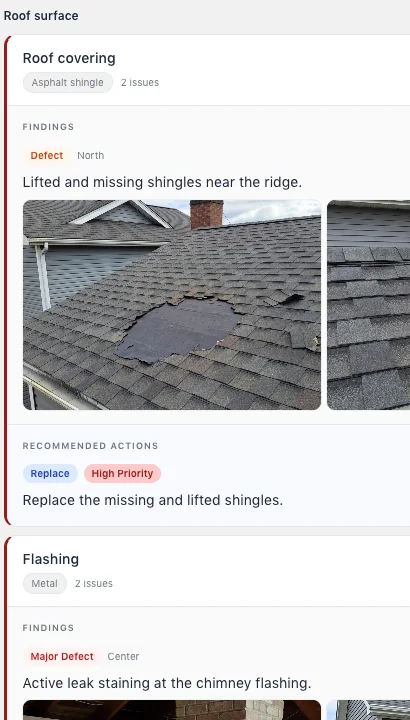
The published report lists each item’s findings with their photos. It shows no capture time for photos.
Sources
- American Society of Home Inspectors, Inc., “ASHI’s Home Inspection Standard of Practice: Approved Changes as of 1/8/26”
- American Society of Home Inspectors, Inc., “ASHI Standard of Practice Changes”
- American Society of Home Inspectors, Inc., “ASHI Standard of Practice for Home Inspections Effective March 1, 2014”
- ASTM International, “C1060 Standard Practice for Thermographic Inspection of Insulation Installations in Envelope Cavities of Frame Buildings”
- FLIR, “FLIR C5 Compact Thermal Camera with Cloud Connectivity and Wi-Fi”